• Click here to access some of the presentations made during the 2022 National Rally

Our updates and an ask for guidance

Midnight Rider

Prominent Member
We picked up a 252RL back on 4/27. Have had it out on one overnighter, just to test the systems and all out (yes, we did a thorough pre-buy inspection, but that doesn't take the place of running it for a night prior to any real camping). Some of the changes we've made already:

  • The stock mattress leaves much to be desired, so that was replaced with one from RV Mattress. It's their 8" model and we'll have to see how that goes, but it's going to be an improvement over stock.
  • Permanently mounted a soundbar under the TV, along with a subwoofer that bluetooths to the soundbar. The sub is permanently mounted under the dining room table via some L-brackets. It's out of the way and seems to work well.
  • My wife has mounted various brackets and things for towels, toiletries, and the like.
  • I used some foam to make a safe liquor storage area for the bottles in a cabinet behind the TV. This way the bottles are upright, won't touch each other, and won't get knocked around during travels.
  • I did add in one additional solar panel.

Next on the list are three bigger projects that I'm starting into are power-related.

  1. We've picked up a 3,000W Renogy inverter that I'm going to wire in. I've found the inverter prep wiring easy enough but have two questions on that:
    1. I see what appear 2 hot, 2 neutral, and 2 ground wires coming out.
      1. Anyone know why I've got two wires? Secondly, is it as simple as running a 3rd wire from those to the inverter and I'm done (at least with that side)? I'm comfortable on the battery side of things, just wondering on AC output side.
      2. Does anyone know if their pre-wiring causes the converter to shut off or will we need to kill that breaker every time we turn the inverter on? If that's the case, I think I'll want to put a transfer switch in there to automate that.
  2. Right now I've got two Renogy LiFePo 100ah batteries up on the tongue, replacing the stock wet cell. My plan is to eventually have 4 of them so we can run the AC unit for a bit when off grid. Because of this, I'd like to move the batteries inside the unit and place them in the storage under the bed. That way temperature doesn't become a problem and it'll make it easier for me to work on things. I think I've heard of folks doing this, so does anyone have any pics and/or a wiring diagram that I can see?
    1. One annoyance I discovered when switching to the two battery set up is that Alliance doesn't have a solid unbroken wire running from wherever in the trailer to the battery. It runs out to near the battery and they've crimped an extender on that's got the battery connectors on it.
    2. I'm asking about this because, since I've got to do some wiring to get the inverter connected to the batteries, it seems like a good idea to also move the batteries and install the inverter all at one time.
  3. Lastly, I'm going to hardwire in a surge protector. Nothing too fancy there, just wiring it in under the dining room seat where the current breakerbox sits.
In the future, probably next season, I'm also planning on doing further upgrades to the solar. That way we can really take advantage of having that inverter. Definitely 2 more panels (200W each). I'd love to get to a point where we could expect a mostly sunny day to charge up the batteries from overnight use such that we don't have run the gennie at all.
Can you send me a picture of the liquor storage system you built? That sounds cool.

Thanks MR
 

George

Well-known member
Put me in the box with $0.02 not an expert commenters. So, Please insert a grain of salt here.
As I understand it the inverter prep box has shore power on one of the two cables and the other goes back to circuit breakers in your distribution panel. They were wire nutted together, right. So what you have is inverter AC-IN and inverter AC-OUT.
 

George

Well-known member
Lastly, I'm going to hardwire in a surge protector. Nothing too fancy there, just wiring it in under the dining room seat where the current breakerbox sits.
@CornCrib did a fine job on his hardwired surge protector.
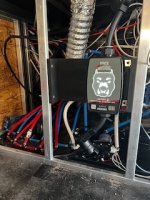
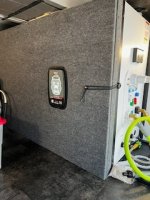
I already owned the portable one so I went this way. It's just a coincidence that it gives me the ability to easily bypass the surge protector should I need to.
 

Attachments

  • IMG_1940.jpeg
    IMG_1940.jpeg
    429.8 KB · Views: 10
  • IMG_1953.jpeg
    IMG_1953.jpeg
    385.2 KB · Views: 10
  • Watchdog Mount .pdf
    26.1 KB · Views: 4
Last edited:

Oregon_Camper

Forum Admin
Staff member
Put me in the box with $0.02 not an expert commenters. So, Please insert a grain of salt here.
As I understand it the inverter prep box has shore power on one of the two cables and the other goes back to circuit breakers in your distribution panel. They were wire nutted together, right. So what you have is inverter AC-IN and inverter AC-OUT.
Depends on the type of inverter being used. Some only create AC power from battery some can have AC/DC in.

Without an inverter with a built-in transfer switch (like Victron) then an external transfer switch is required. Without a transfer switch, there is potential for shore power and inverter both trying to power those circuit.

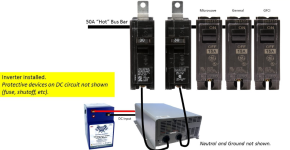
This shows how the inverter prep loop is setup. From factory, the inverter in the image is just the box, with the wires connected.

1773554371829.png
 
Last edited:

George

Well-known member
@Oregon_Camper
Thanks for the clarification Jim. I oversimplified and should have said "AC-IN to a transfer switch" (built-in to the inverter or separate). 👍🏼
Since I don't have inverter prep would I probably have to change out my power center to have a split bus? Or install enough battery and inverter for the whole kit and caboodle?$$$$
 

Oregon_Camper

Forum Admin
Staff member
@Oregon_Camper
Thanks for the clarification Jim. I oversimplified and should have said "AC-IN to a transfer switch" (built-in to the inverter or separate). 👍🏼
Since I don't have inverter prep would I probably have to change out my power center to have a split bus? Or install enough battery and inverter for the whole kit and caboodle?$$$$
Starting from scratch is a much better solution, IMHO. The basic concept is you remove the incoming power line from shore line (at circuit breaker) and move that to the "incoming" line on inverter. Then run a new line from inverter "out" back to same spot on circuit breaker. Attach your battery back to the "DC In" posts and done. Of course there are fuses and cut off switches involved, but that is the concept.

Here is a drawing of a system I installed on a friends Grand Design. The "3" line in this drawing just goes off to nothing, as I didn't have the correct image of his compartment with the 12v distribution bus.

1773587963598.png
 

George

Well-known member
Starting from scratch is a much better solution, IMHO.
And since the Victron is also a charger one would remove the OEM converter or at least remove/disconnect it's AC and/or DC circuit breaker(s), correct ?
I've seen some folks use 2 of the 120v Victrons. What'd be the advantage of that over one 230V box? Capacity?
 

Oregon_Camper

Forum Admin
Staff member
And since the Victron is also a charger one would remove the OEM converter or at least remove/disconnect it's AC and/or DC circuit breaker(s), correct ?
I've seen some folks use 2 of the 120v Victrons. What'd be the advantage of that over one 230V box? Capacity?
I left my converter where Alliance put it. If I ever sell the RV, I could take the Victron system out and simply turn the factory converter back on. Wires from converter are capped off and the wires are off the breaker.

Folks install 2x Victron systems to have 2x the power. They have massive battery and solar setups to do this. Then they can run AC's...microwave...etc and the same time without worrying about tripped the inverter. We have one in our Alliance and I had one in our prior RV. I don't see the need to 2x, but we don't live in our RV, so full timers could have a need for 2x.
 
Top