
• Click here to access some of the presentations made during the 2022 National Rally

Water #1 and Water #2

CaptTPT

Active member
See pic
#1: Owners manual says “Note:Do not overfill tank”. What does this mean? There is an overflow line which drains when the tank is full. Why is this present? Are we supposed to fill only until the monitor light says full, or continue until we see overflow? Of course there is quite a bit of volume remaining when the monitor light says full. What is the correct way to fill the tank? Why have an overflow line if not to determine when the tank is full?
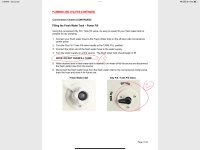
#2: Should the system be completely depressurized before turning the valve position? I’ve seen it suggested that we should completely depressurize the system before moving the valve position and that not doing so will cause damage. Manual does not address this. What say you?
 

Attachments

  • IMG_1388.jpeg
    IMG_1388.jpeg
    176.5 KB · Views: 7

Lantley

Elite Member
I fill until the monitor sells full. The overflow is there as a safety to keep some one from overfilling the tank to the point of bursting the tank. If you over fill the tank it will not burst. The excess water will be released via the overflow.
However when you over fill the tank and water comes out of the over flow. you can create a siphon that will drain the tank. You end up losing more water via siphoning action. In the end the tank is not full because several gallons were siphoned out.
Also if you over fill you can loose excess water as you travel water will drain via the overflow.
Using the level monitor, a flow gage or a timer is the most effective method.
 

Midnight Rider

Prominent Member
I find it best not to over fill the tank. I fill it about 80% It’s lots of water and lots of weight if you are going down the road. If at an rv park don’t fill it just run off city water inlet.If boon docking and you have to max out the tank, try and fill up close to final destination so as not to haul all the weight. I think it’s close to 8 lbs per gallon or something like that? So an over filled 100 gallon tank might weigh over 800 lbs! Plus’s whatever else you got packed on board And it all ads up fast And all a sudden you maxed out!
As for the overflow valve, it will start draining when tank is FULL FULL FULL! That is so you don’t flood your camper, burst pipes due to pressure, and all that fun stuff. That said I have had my rig parked at an angle on a steep road shoulder and had my overflow valve start syphoning my water tank into the dessert sand. That was because my tank was over full for going down the road And once it started poring out I could not stop it until I pulled out and got level? It’s Crazy what can happen in these things?
its sort of personal preference, I don’t like water leaks under my coach and I watch for it like a hawk. So overflowing my water tank is not my personal preference. It won’t hurt to overflow now and again but I just don’t try and make it happen to know my tank is full. How ever some are just fine with it?
as for being under pressure and turning the nobs at the Nautalis control box. I always adjust the nobs then pressure up. If I want to change function after that I let pressure out then adjust and pressure back up.
like with the tanks being over full or valves being under hard pressure And turned I don’t like to push everything all the time. Try and baby things a bit and it seems to work better.
 

CaptTPT

Active member
If the overflow is plumbed to the top of the tank with a bulkhead fitting then pressure and pressure only will cause water to flow out. Siphon is impossible unless there is line extending below the water level at the upper surface of the tank. If there is an extension from the bulkhead fitting below the upper surface then siphon will occur only to the level of the extension. Then it will stop. In any case, that’s when the tank is full. Correct? Is it possible they just don’t want the possibility of pressure in the tank for some reason? Some city water systems may have 60 psi or more. Is it possible that could damage the tank? Certainly an overflow would bleed off the majority of that pressure. Other thoughts? Any ideas on the valve?
 

CaptTPT

Active member
One more thing. If you are planning to dry camp you/I may need every gallon you can get. Yes water is 8.34 lbs per gal, but if it were unsafe to fill the tank before leaving home don’t you think the manufacturer would tell us that the tank is not designed to be full when driving?
 

Lantley

Elite Member
You can put a valve on the overflow line. However you need to remember to open it when using water and when filling the tank.
Forgetting to open valve can create serious issues
 

CaptTPT

Active member
I must not be seeing something here. The video does not show anything useful to answer my question. Maybe someone would explain the mechanism of how a siphon will occur with an overflow vent on the top of the tank. Closing a valve placed on an overflow line would be a terrible idea. You would not be able to fill the tank (need air escape) nor empty the tank (need air inflow).
 

Lantley

Elite Member
Adding a valve is not a horrible idea. My last RV was an Open Range. Many Open Range owners including myself added valves to control siphoning.
The valve will work to ensure you arrive at your site with all of the water you put into your tank vs. having gallons of water siphon or simply spill out as you travel.
The key is to remember to open the valve when you arrive at your destination.
For the record open range had both a vent and overflow lines. for whatever reason they siphoned very easily, which is why many added valves to both lines.

Keep in mind the tank walls are not totally ridged. They are somewhat soft and flexible.
The tanks sort of bend and contort as they fill up his helps to create the siphon.
The soft sided tanks sort of become a bladder which squeeze and contort as they fill to capacity. This helps create the siphoning action. The siphoning action is real not imagined.
 

fyrmnjim

Member
One more thing. If you are planning to dry camp you/I may need every gallon you can get. Yes water is 8.34 lbs per gal, but if it were unsafe to fill the tank before leaving home don’t you think the manufacturer would tell us that the tank is not designed to be full when driving?
It's not unsafe to fill your tank. It's just that you'll be towing 800 more pounds down the road and dragging down your mileage as well as excess wear and tear on your tires and suspension.
 
Top