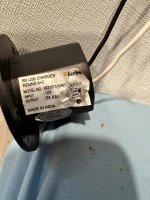
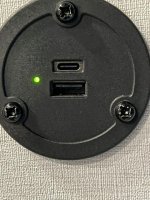
Thank you for the responses. When I took the port out of the wall, I could clearly see the sticker saying that it was a 5V and 4.8-amp charger output. My frustration is that when I am trying to plug in a phone it won't show connection at all on the phone. I am not worried about it being a slow charger and may take several hours (aka. overnight) to charge a phone. That is why I also tried using a backup battery "brick" I have had for a long time. It will charge off anything. It goes fast when on the quick charge(aka. PD charger) and go slow when using a regular USB-C. In-fact until I got this travel trailer, I had never run into any type of USB charger the brick wouldn't try to accept charge from. I just want it to actually connect like the USB-A port does. Not having a plethora of cables to pick from and being "old" I personally use a USB-A mostly for my phone, but my children are accustomed to using a USB-C cable to charge their phones, thus how I came to have multiple cables for my testing. After I pulled the charge port out of the wall and showed them the sticker, I told them that is why it won't charge laptops or even tablets. Doing the math, 5V @4.8A minus some resistance (typical heat and cable connections) should equal about 20-24W of power (being 5V output). Their laptop/tablet chargers will require somewhere between 65-100W (@ around 18-20V) of power to accept a charge with the output voltage being half of the equation and the wattage being the other half. I equated it to them by showing a single 12V battery won't necessarily start a 24V engine in a big truck and can actually damage things if attempted. However, a phone is a much smaller power device that is supposed to accept 5V for the (phone)input voltage. Thus, the Wattage or Amps is what controls the speed.
My personal theory is that Alliance had gotten a "bad batch" of these chargers in from their supplier when my unit was originally made. It kind of looks like the plastic cover is not centered correctly (or isn't large enough) and won't allow the cord to plug in all the way for the USB-C on a subsequent inspection OR there is an internal failure on the USB-C port. Since the little green light comes on and either that was probably good enough for the "PDI" checks or potentially someone just plugged something into the USB-A and everything worked so they let them fly. Since the cover won't snap off the port, I didn't really want to do some destructive testing just to end up having to eat a cost that I shouldn't since it is clearly still under warranty.
In the end of it all, I really wish I had followed the advice from Nick("RV Tech") I have seen him give on YouTube and just been the really big pain in the butt and cycled every single switch and feature before I went in to sign papers the day we took delivery. But I didn't want to have the relationship go completely south with my dealer from the word go as they did come recommended to me and being in service industry, I know relationships are way more important than anything else most of the time.