• Click here to access some of the presentations made during the 2022 National Rally

Proper Tire Pressures on 5th Wheel - 23ML

Slats

Member
I'm interested in what pressures I should be running in my 23ML 5th wheel tires. I went to a CAT scale fully loaded and the weight on the 23ML tires was 7960 lbs. This means each of the 4 trailer tires is carrying on average 1990 lbs (assuming equal loading left / right and front / rear). I looked at the sticker on the 23ML and it has Goodyear Endurance Special Trailer (ST) tires of ST235/80R16 LRE (Load Rating E).

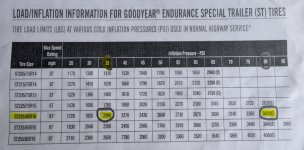
Next I went to the Goodyear website and found the load rating chart for these tires. The chart shows when these tire have 35 psi, each tire can carry 2090 lbs (remember the CAT scale showed the average load each tire was supporting was 1990 lbs). At 80 psi cold, these tires can carry 3420 lbs each.

I had been setting my tire pressure between 75 and 80 psi cold as I was told that trailer tires usually time out (7 years) and should be replaced well before they wear out their tread. Now I'm wondering whether I should be running much lower pressures to give the 5th wheel a gentler ride where the tires absorb more of the impact from the road so less impact is transmitted to the frame / body. If I should run them at lower pressure, what pressure should I choose? 35 psi seems way too low - I was thinking more like 50 to 60 psi. Would appreciate any advice folks have. Thanks.
 

Attachments

  • Goodyear Endurance Load Rating Chart.jpg
    Goodyear Endurance Load Rating Chart.jpg
    440.6 KB · Views: 11
  • 23ML Tire Loading Information.jpg
    23ML Tire Loading Information.jpg
    395.9 KB · Views: 12

BryanValRox

Elite Member
I'm interested in what pressures I should be running in my 23ML 5th wheel tires. I went to a CAT scale fully loaded and the weight on the 23ML tires was 7960 lbs. This means each of the 4 trailer tires is carrying on average 1990 lbs (assuming equal loading left / right and front / rear). I looked at the sticker on the 23ML and it has Goodyear Endurance Special Trailer (ST) tires of ST235/80R16 LRE (Load Rating E).

Next I went to the Goodyear website and found the load rating chart for these tires. The chart shows when these tire have 35 psi, each tire can carry 2090 lbs (remember the CAT scale showed the average load each tire was supporting was 1990 lbs). At 80 psi cold, these tires can carry 3420 lbs each.

I had been setting my tire pressure between 75 and 80 psi cold as I was told that trailer tires usually time out (7 years) and should be replaced well before they wear out their tread. Now I'm wondering whether I should be running much lower pressures to give the 5th wheel a gentler ride where the tires absorb more of the impact from the road so less impact is transmitted to the frame / body. If I should run them at lower pressure, what pressure should I choose? 35 psi seems way too low - I was thinking more like 50 to 60 psi. Would appreciate any advice folks have. Thanks.
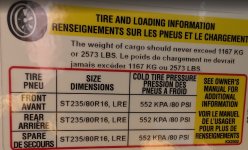
Any chance you have a picture of your rig on the scales or can you post a picture of your ticket?
As you point out, there is a huge gap between the Alliance’s Tag and recommended pressure vs the Goodyears chart.

Also on the chart some of the numbers have (x) beside them, what does the foot note mean?

1990x2 would imply less than 4k per axle
 

Slats

Member
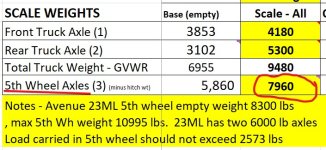
Here are the 3 weights from the scale ticket that I entered into my Excel spreadsheet - Steer, Rear wheel, Trailer. I did measure tongue weight of the 23ML loaded and it was 2100 lbs so the numbers add up. I confirmed that the wheels were properly positioned on the scale both left / right and which wheels were on which scale pad.

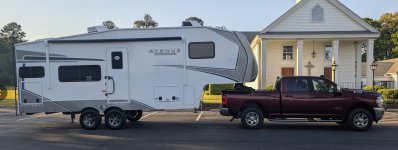
I don't have a picture from the scale but attached is a picture of the rig - 2023 RAM 2500 6.4L Hemi & 2025 Alliance Avenue 23ML 5th wheel. I'm just wondering whether Alliance put beefier wheel / tires on the rig to ensure no issues with tires failing which give a brand a bad name (like I had happen with my previous GD rig with Westlake tires from China).
 

Attachments

  • Scale Weights.jpg
    Scale Weights.jpg
    93.4 KB · Views: 27
  • Picture of 2023 Ram 2500 6.4 Hemi with 23ML 5th wheel.jpg
    Picture of 2023 Ram 2500 6.4 Hemi with 23ML 5th wheel.jpg
    222.9 KB · Views: 24

Slats

Member
Also, I'm not sure if Alliance's tag with tire pressures is 'recommended' pressures or 'maximum' pressures. The tires themselves indicate 80 psi max pressure cold.
 

Chaseweston

Well-known member
I agree 35psi sounds way too low. I also personally wouldn't reduce tire pressures to soften the ride on a trailer. I have always filled to pressure on the sidewall to achieve stated capacity rather than play around with reducing pressure based on a charted rating.

What is the asterisk on their definition of "normal highway service"

Our unit has 15,360lbs on the (3) axles so we are in a league of our own, comparatively, and I run them at 110psi cold, religiously. They get up to about 118-120 at temp in hot climates. I wouldn't want a blowout to cause overloading on the other tires because I dropped them down to try for a better ride. Redundancy is your friend on the road.
 

BryanValRox

Elite Member
Here are the 3 weights from the scale ticket that I entered into my Excel spreadsheet - Steer, Rear wheel, Trailer. I did measure tongue weight of the 23ML loaded and it was 2100 lbs so the numbers add up. I confirmed that the wheels were properly positioned on the scale both left / right and which wheels were on which scale pad.

I don't have a picture from the scale but attached is a picture of the rig - 2023 RAM 2500 6.4L Hemi & 2025 Alliance Avenue 23ML 5th wheel. I'm just wondering whether Alliance put beefier wheel / tires on the rig to ensure no issues with tires failing which give a brand a bad name (like I had happen with my previous GD rig with Westlake tires from China).
I have a question regarding your 5th wheel line entry.
You have a note in that line “ minus hitch weight”. Did you subtract something from that entry? If you did you shouldn’t have. The weight on the tires is the weight on the tires, so the original value should be used.

Just trying to make sense of this, I can’t wrap my head around a 35 psi entry in the chart and Alliance‘s recommendation of 80. I fully understand that tires don’t always have to be inflated to the max side wall value, BUT Wow! Something just seems off to me( could just be me)

It just seem very odd to me that your 6K axles would only be carrying @4k each. But hey, I guess anything is possible.
 

BryanValRox

Elite Member
Here are the 3 weights from the scale ticket that I entered into my Excel spreadsheet - Steer, Rear wheel, Trailer. I did measure tongue weight of the 23ML loaded and it was 2100 lbs so the numbers add up. I confirmed that the wheels were properly positioned on the scale both left / right and which wheels were on which scale pad.

I don't have a picture from the scale but attached is a picture of the rig - 2023 RAM 2500 6.4L Hemi & 2025 Alliance Avenue 23ML 5th wheel. I'm just wondering whether Alliance put beefier wheel / tires on the rig to ensure no issues with tires failing which give a brand a bad name (like I had happen with my previous GD rig with Westlake tires from China).
Might just be me or the picture, but in the what it is worth department, you appear to running nose high and have ample bed rail clearance. If it were mine, I would raise the GenY by One hole and revaulate.

I know you did ask for my opinion, so I am sorry if you feel this is overreaching, just trying to help level you out some to help with weight distribution on the trailer axles.
 

UGA Fan

Member
Your spreadsheet seems to indicate that your truck’s front axle weight increased by 327 lbs. when you connected the trailer. That’s odd - I would have expected the front to be lighter with the trailer that it is when empty.
 

BryanValRox

Elite Member
Your spreadsheet seems to indicate that your truck’s front axle weight increased by 327 lbs. when you connected the trailer. That’s odd - I would have expected the front to be lighter with the trailer that it is when empty.
It would not be unusual to have the front axle weight increase with the trailer hitched up. All of the hitch weight has to find a way to the ground somewhere . I guess it really depends on your set up as to where the weight finds a path to ground, the frame of truck transfers some of it.
In our case our 310 RL adds about 200 lbs to the front.
Certainly many other things factor in, so everyone will experience something different with their truck, trailer type and hitch type.
 

UGA Fan

Member
It would not be unusual to have the front axle weight increase with the trailer hitched up. All of the hitch weight has to find a way to the ground somewhere . I guess it really depends on your set up as to where the weight finds a path to ground, the frame of truck transfers some of it.
In our case our 310 RL adds about 200 lbs to the front.
Certainly many other things factor in, so everyone will experience something different with their truck, trailer type and hitch type.
Ok so if I accept that premise, his pin weight is 2525 - not 2100 as stated by the OP.
 

RockDr896

Prominent Member
Cynical guy here again...like all licensed professionals...in this case Ford, Chevy, and Dodge...build a tow vehicle. Trailer engineers & RV Engineers (as an example) say....lets make a product those things can pull....sort of like a cordless drill now days and all the attachments they make for them. So lets call the RV industry, the attachment builders....So now we have a truck (The cordless drill) and the RV (The attachment)...both write their "legal verbiage" to avoid the liability, in case it is the operator or the drills problem. They also go to great lengths to use different quantitative methods and terminology as protection. In court, liability or negligence is a long and hard road to prove. Especially if verbiage differences are at the heart of the matter. This is why I upgraded to 8,000 lb axles, because bigger is always better and easier, than playing by a manufacturers engineering margins. This is why I also bought a f350 dually and avoided the engineering margins of a single axle. The drill supplier and the attachment supplier, will not be there to take responsibility in the end in most cases. I say, go big or go home.....trying to debate the licensed professional of those industries is a HUGE waste of time.

Back to the topic of this thread. I hope the answers given above, help you wrap your mind around your curiosity. All great answers, to a very complicated problem purposely created by the industries I mentioned. I think you have a bust in your numbers. I am quite sure, that an axle rated for 8,000 lbs can carry that, as well as the tires they mounted. The RV industry, is most likely guilty of not balancing the weights from right to left. I see no evidence of how their frames transfer/distribute a right to left weight. When I setup 7K cranes on my service trucks, my only option was to beef up the leaf springs on the crane side. I don't see that in RV's....but I will admit, it could be an ignorant opinion. The only way I can prove it, would be to break out the individual scales and take some weight readings on each tire, like they did with my super load trailers that moved my equipment across the country.

Reducing your tire pressures, in order to get a better ride.....I think you would be exercising your right to do your own thing, but I personally think it is a dangerous move to step outside the specifications of each manufacturers guidelines.
 

BryanValRox

Elite Member
Ok so if I accept that premise, his pin weight is 2525 - not 2100 as stated by the OP.
Can’t debate your point, and I am only making a statement not taking a position.
The post has driven some questions to be ask for further contex and understanding of his numbers.

I think I can say with confidence that the most accurate hitch weight should be measured without any tow vehicle involved. Not saying that is practical for most owners to do.
 

BryanValRox

Elite Member
Cynical guy here again...like all licensed professionals...in this case Ford, Chevy, and Dodge...build a tow vehicle. Trailer engineers & RV Engineers (as an example) say....lets make a product those things can pull....sort of like a cordless drill now days and all the attachments they make for them. So lets call the RV industry, the attachment builders....So now we have a truck (The cordless drill) and the RV (The attachment)...both write their "legal verbiage" to avoid the liability, in case it is the operator or the drills problem. They also go to great lengths to use different quantitative methods and terminology as protection. In court, liability or negligence is a long and hard road to prove. Especially if verbiage differences are at the heart of the matter. This is why I upgraded to 8,000 lb axles, because bigger is always better and easier, than playing by a manufacturers engineering margins. This is why I also bought a f350 dually and avoided the engineering margins of a single axle. The drill supplier and the attachment supplier, will not be there to take responsibility in the end in most cases. I say, go big or go home.....trying to debate the licensed professional of those industries is a HUGE waste of time.

Back to the topic of this thread. I hope the answers given above, help you wrap your mind around your curiosity. All great answers, to a very complicated problem purposely created by the industries I mentioned. I think you have a bust in your numbers. I am quite sure, that an axle rated for 8,000 lbs can carry that, as well as the tires they mounted. The RV industry, is most likely guilty of not balancing the weights from right to left. I see no evidence of how their frames transfer/distribute a right to left weight. When I setup 7K cranes on my service trucks, my only option was to beef up the leaf springs on the crane side. I don't see that in RV's....but I will admit, it could be an ignorant opinion. The only way I can prove it, would be to break out the individual scales and take some weight readings on each tire, like they did with my super load trailers that moved my equipment across the country.

Reducing your tire pressures, in order to get a better ride.....I think you would be exercising your right to do your own thing, but I personally think it is a dangerous move to step outside the specifications of each manufacturers guidelines.
RockDr896, I to specked many a service truck and had to always spec in heavier springs on the crane side to make her sit level. Small world!
 

M and E

Prominent Member
The chart and the placard on the RV answer two different questions.

The Goodyear load chart tells us what the tire is capable of carrying at a given pressure. So the 2,080 lbs at 35 PSI is a legitimate rating if we are only considering the tires capability.

The Alliance placard tells us what pressure Alliance specifies for that tire on that trailer. That accounts for the trailer’s rated loading, not just what it weighs on a CAT scale.

The chart isn’t wrong but also doesn’t mean Goodyear is recommending 35 PSI for the RV. Goodyear (Cooper , Sailun, others) specifically says to maintain the pressure published by the RV manufacturer on the placard I think in the same document that has the load ratings.

There are many better ways to improve suspension related towing experiences than to reduce PSI, IMO and respectfully. Too risky in my book. But that’s me.
 

Slats

Member
I have a question regarding your 5th wheel line entry.
You have a note in that line “ minus hitch weight”. Did you subtract something from that entry? If you did you shouldn’t have. The weight on the tires is the weight on the tires, so the original value should be used.

Just trying to make sense of this, I can’t wrap my head around a 35 psi entry in the chart and Alliance‘s recommendation of 80. I fully understand that tires don’t always have to be inflated to the max side wall value, BUT Wow! Something just seems off to me( could just be me)

It just seem very odd to me that your 6K axles would only be carrying @4k each. But hey, I guess anything is possible.
The Excel sheet calculates lots of parameters (e.g. for comparison to GVWR, GVCWR, etc.). The 'minus hitch weight' is just a note to the user that it does not include the hitch weight that is being carried by the truck. Nothing is subtracted from the actual values on the scale ticket. Appreciate the feedback regarding not lowering tire pressure to provide a gentler ride to the trailer.
 

Slats

Member
Might just be me or the picture, but in the what it is worth department, you appear to running nose high and have ample bed rail clearance. If it were mine, I would raise the GenY by One hole and revaulate.

I know you did ask for my opinion, so I am sorry if you feel this is overreaching, just trying to help level you out some to help with weight distribution on the trailer axles.
You are correct that I'm running a little nose high but there is a reason. What may not be obvious from the picture is that this RAM 2500 has RAM boxes which makes the bed narrower. I uncomfortable adjusting the hitch / pin box to lower the front because the clearance is minimal on the inside of the bed due to it being narrower (not the height over the bed rail). Wish I had options here. Appreciate the suggestions.
 

Slats

Member
Your spreadsheet seems to indicate that your truck’s front axle weight increased by 327 lbs. when you connected the trailer. That’s odd - I would have expected the front to be lighter with the trailer that it is when empty.
The Base (empty) weights are actually from the RAM specs. I did not weigh the truck empty ($15/weigh starts to get expensive) and I have the truck loaded with stuff in front of the rear axles that were there when going across the scales (e.g. tools, 2 people in vehicle when being weighed, etc.).
 

Slats

Member
Ok so if I accept that premise, his pin weight is 2525 - not 2100 as stated by the OP.
I actually determined the pin weight by weighing just the pin using a 2000 lb scale. It was slightly more than 2000 but not pegged out. Can't believe Alliance Avenue spec sheet on 23ML indicates 1200 lb 5th wheel tongue weight.
 

Slats

Member
Cynical guy here again...like all licensed professionals...in this case Ford, Chevy, and Dodge...build a tow vehicle. Trailer engineers & RV Engineers (as an example) say....lets make a product those things can pull....sort of like a cordless drill now days and all the attachments they make for them. So lets call the RV industry, the attachment builders....So now we have a truck (The cordless drill) and the RV (The attachment)...both write their "legal verbiage" to avoid the liability, in case it is the operator or the drills problem. They also go to great lengths to use different quantitative methods and terminology as protection. In court, liability or negligence is a long and hard road to prove. Especially if verbiage differences are at the heart of the matter. This is why I upgraded to 8,000 lb axles, because bigger is always better and easier, than playing by a manufacturers engineering margins. This is why I also bought a f350 dually and avoided the engineering margins of a single axle. The drill supplier and the attachment supplier, will not be there to take responsibility in the end in most cases. I say, go big or go home.....trying to debate the licensed professional of those industries is a HUGE waste of time.

Back to the topic of this thread. I hope the answers given above, help you wrap your mind around your curiosity. All great answers, to a very complicated problem purposely created by the industries I mentioned. I think you have a bust in your numbers. I am quite sure, that an axle rated for 8,000 lbs can carry that, as well as the tires they mounted. The RV industry, is most likely guilty of not balancing the weights from right to left. I see no evidence of how their frames transfer/distribute a right to left weight. When I setup 7K cranes on my service trucks, my only option was to beef up the leaf springs on the crane side. I don't see that in RV's....but I will admit, it could be an ignorant opinion. The only way I can prove it, would be to break out the individual scales and take some weight readings on each tire, like they did with my super load trailers that moved my equipment across the country.

Reducing your tire pressures, in order to get a better ride.....I think you would be exercising your right to do your own thing, but I personally think it is a dangerous move to step outside the specifications of each manufacturers guidelines.
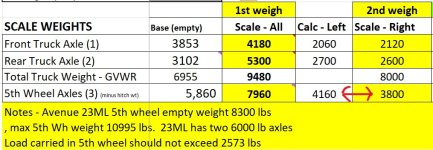
Appreciate the reply and questions. I did measure the 5th wheel twice to get the left to right weights (just didn't show it on the first picture as I didn't want to confuse people). 1st weigh had both left and right wheels on the platform. 2nd weigh had only the right wheels on the platform. I calculated the difference to determine the left wheel weights on the trailer. You can see that the left side weight 360 lbs more than the right side.

The left side had the refrigerator, oven, microwave and the slide so this makes sense that it is heavier. I'm guessing that Alliance is using tires / wheels / axles that are rated high enough that differences in weight between left / right due to construction / loading and differences between front trailer axle and rear trailer axle due to hitch height / loading don't really matter. Given the feedback everyone has provided, I think I'll continue to run with pressures between 75 and 80 psi. Thanks!!!
 

Attachments

  • Scale Weights Left to Right.jpg
    Scale Weights Left to Right.jpg
    119 KB · Views: 3

BryanValRox

Elite Member
You are correct that I'm running a little nose high but there is a reason. What may not be obvious from the picture is that this RAM 2500 has RAM boxes which makes the bed narrower. I uncomfortable adjusting the hitch / pin box to lower the front because the clearance is minimal on the inside of the bed due to it being narrower (not the height over the bed rail). Wish I had options here. Appreciate the suggestions.
Understand, thanks for sharing.
You do you, but I guess I am having trouble understanding how lowering the nose by 1 hole would alter the swinging radius of the hitch when turning and risking contact with the ram boxes. Maybe there is just something I can ‘t see or am to hard headed to understand (most likely the later)😂. Enjoy the new rig!!
 
Top