• Click here to access some of the presentations made during the 2022 National Rally

Adding Inverter/Batteries

We just purchased a New 2022 Valor 41V15 last summer. We gave it a couple of good shake down trips with a few small issues. The biggest issue was the generator wouldn't run reliably and I think we finally got the onboard Onan Generator running right after about 30hrs of run time/trouble shooting. That's a whole other story! My wife and I are wanting to take our kids to the mountains Boondocking to ride SXS's and not run the Generator if possible maybe to only charge the Batteries. We have the basic solar package installed on our Valor (2 large solar panels and 40Amp Renogy Solar Charger and (1)-100Ah Lithium Battery).

I am thinking of adding a Second battery to match the what is currently installed and also installing a 3000W Renogy Pure Sine Wave Inverter. To Start I think I am just going to run a 10ga. heavy extension cord to the inverter from the shore power connection on the camper and then turn the converter off. I would eventually like to tie everything together in the breaker panel so it is a clean install and then I don't have to drag out cords every time we go boondocking.

Has anyone ever done this before? Is 2-100Ah batteries enough? I am new to Solar and still learning so any help advise or input would be helpful!

Thanks!
 

Chaseweston

Well-known member
There are a lot of variables to consider here. The main question is what are you wanting to run/use while boondocking?


We have a '24 44V14 with base solar (on ours that's 640 watts of PV and 100AH li) and have boondocked on top of Mt. Roosevelt above Deadwood, SD for two weeks straight only using generator for an hour or so in the evenings to run the air fryer, pump water into the fresh tank, etc. - Loads we had on the battery are the 12v fridge, the TMobile Wifi, bedroom tv in the evening, shark fan in the evening, and some lights , water pump, gas water heater, etc.

Our 100 AH capacity was barely keeping us going overnight and would need the sun desperately in the morning's even with the top up from the generator in the evenings. We'd frequently be in the 10%-20% by the time the PV started charging again in the am. While this worked for the two weeks we were there, it was definitely on the edge. I would have much preferred another 300AH to not have to worry every morning if the fridge fried another control board again because the battery was at 0.

Some things to consider on your intended setup:

Adding AC loads via inverter - you will absolutely want more capacity - look into temgot, litime, ecoworthy batteries on amazon, they can be had for quite a deal sometimes. I just saw a 2 pack of 280AH eco-worthy for $750 and free shipping, they are $850 now and that's still a good deal for 560 AH with built in Bluetooth and 200A BMS. A single one is $460 right now.

Wiring - To use your shore power cord hooked to the inverter, you'll need to install a 30amp RV receptacle off the AC out terminals on the inverter (the inverter you listed has a continuous output rating of 25 amps) otherwise if you just plug into the outlets on the inverter, it'll only be 15amp, which is fine too if you are only going to be pulling that or less at any given time, but if so, see the next point.

Choosing the right inverter - I would take a look at what loads you realistically need / want to run on DC power. Installing the 3000w inverter and only using 1/3 capacity is less efficient and has higher idle draw than properly sizing the inverter for intended use. If you are only going to be plugging an extension cord into the outlet on the inverter, you are limiting yourself to only 1800W anyways and in that case should probably size down to the 2000w inverter, save some money towards battery capacity and keep rolling. Remember, a lot of the loads in the Valors are on 12v anyways, so your biggest bang for your buck is going to be battery capacity and then inverting only the outlets you really need/want to run off DC while boondocking; maybe a coffee pot, the living room tv, an outlet to charge laptops, etc.

once you determine the above, look at Renogy's inverter series' with the built in UPS. You can install it to pass through grid power when connected to shore and then automatically switch to inverted power when boondocking without having specific inverted outlets and maintaining your generator as a full rig backup source.

Hope this gives you some food for thought.
 
We actually plan on boondocking over Memorial Day in the Black Hills possibly by Custer, sounds like it might we a little cool that weekend. I guess we will see if any spots are open! As far as the power consumption goes we would mainly plan on charging small devices, coffee maker, furnace, refrigerator, some lights, star link, and a tv or 2 in the mornings and evenings is about it. The only other time we have Boondocked was at Nascar Races but usually you just leave the generator run because it was so hot outside to keep the AC going. Plus that was about 3 campers ago and things have changed quite a bit since then.

My main concern was how long would our setup would currently run on a 100Ah battery.

Thank you so much for the input!
 

UFF

Well-known member
Working through the same questions myself. I installed a 2000w inverter and just plug the camper into to it. Installed 300 amp hr battery at the same time. Tested all the 12 volt lights so far. Will start the fridge tonight and see what it pulls. I have to shut off the converter when I start the inverter so it isn’t trying to charge the battery. Sorry for the hand writing. I’ll post how much my TV is pulling along with the coffee pot and water pump. Note the #’s I am posting are off the battery blue tooth app.
 

Attachments

  • IMG_6432.jpeg
    IMG_6432.jpeg
    344.4 KB · Views: 21
  • IMG_6430.jpeg
    IMG_6430.jpeg
    442.3 KB · Views: 20
  • IMG_6429.jpeg
    IMG_6429.jpeg
    486 KB · Views: 16
  • IMG_6427.jpeg
    IMG_6427.jpeg
    312.4 KB · Views: 19
  • IMG_6452.jpeg
    IMG_6452.jpeg
    456 KB · Views: 23

JWalker

Well-known member
We just did a test night with our new 2000w inverter/300 AH battery bank.

12 hour. – 8:30pm - 8:30am.
Converter shut off.
No Solar charge
Started with 100% SOC
87ah useage.

items running
-Various interior lighting
-Wi-Fi router
-TV + Roku- about 5 hrs
-2nd tv for about an hour.
-Refrigerator on propane
-2 phone chargers
-One CPAP machine
-2 night time ambient lights
-Water pump a few times during the night


1747068855964.png
 

Chaseweston

Well-known member
Update on Eco-Worthy pricing above!

Eco-Worthy has the 2 pack of 280AH batteries on sale right now via amazon for $730 shipped. You have to use the promo code: 27HF4TY4 at final checkout under payment type drop down but I just checked it and it works. Killer deal.

2 Pack Eco-Worthy 280AH Link

Looks like even adding just one 280AH to your setup would get you by with what you're planning on so long as you don't run into consecutive cloudy days. That's why I'd prefer more storage to hold onto the power that the panels make when it is sunny.
 
Working through the same questions myself. I installed a 2000w inverter and just plug the camper into to it. Installed 300 amp hr battery at the same time. Tested all the 12 volt lights so far. Will start the fridge tonight and see what it pulls. I have to shut off the converter when I start the inverter so it isn’t trying to charge the battery. Sorry for the hand writing. I’ll post how much my TV is pulling along with the coffee pot and water pump. Note the #’s I am posting are off the battery blue tooth app.
Did you hardwire your inverter into your breaker panel or did you tie it into the transfer switch if you have a generator? I have heard it being done either way. IMO, I think the transfer switch would be the easiest and then I would just need to fish the remote on/off switch up to the location I want it at.
I also did purchase the 2000W Renogy Pure Sine Wave Inverter last night and a Eco-Worthy 280AH Li Battery off amazon last night along with 1/O wire and crimp eyelets to hook everything together. So we will see how this goes!
 

UFF

Well-known member
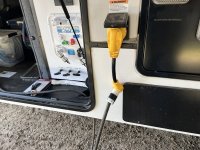
Here is how I done mine. Wire to basement then have short 10gauge cord and hook it up to camper.
 

Attachments

  • IMG_6510.jpeg
    IMG_6510.jpeg
    684.4 KB · Views: 16
  • IMG_6512.jpeg
    IMG_6512.jpeg
    631.1 KB · Views: 16
  • IMG_6513.jpeg
    IMG_6513.jpeg
    560.1 KB · Views: 16

JWalker

Well-known member
Here is how I done mine. Wire to basement then have short 10gauge cord and hook it up to camper.
I plan on something similar. For now I just used a spare 30amp RV cord and plugged directly into the inverter.
I’m probably going to hardwire an RV outlet from the inverter to the inside basement wall and come up through the access point like you did.
1747147131135.jpeg
 
  • Like
Reactions: UFF

Lantley

Prominent Member
I guess it depends on your end game. I have always felt that powering all the outlets was a waste vs. powering just what you need.
The inverter uses power idling even when items are not being used.
Additional idling circuits increase that idling power usage.
While I don't believe the idling currents are significant it is a factor to be aware of.
Also powering all outlet increase residual 120 voltages like microwave display or keeping TV in ready state.
The powering everything is certainly viable but at what residual cost? More importantly will the residual power impact your end game usage
 
Has anyone installed an inverter and then tied into the shore power side of the transfer switch for the Generator? Versus pulling wire up clear up to the breaker panel and up in the kitchen? Just curious.
 

Chaseweston

Well-known member
Has anyone installed an inverter and then tied into the shore power side of the transfer switch for the Generator? Versus pulling wire up clear up to the breaker panel and up in the kitchen? Just curious.
You can either run cascading ATS's (two ATS's for the three sources) or install an appropriately sized inverter with built in ATS after the stock ATS. Not my drawing below but shows what I am referring to. cascaded ATS.JPG

Reference for photo and good read on the topic: Dual transfer switch thread
 
I am providing an update with our battery upgrade and inverter install that I finished last week. We took the family to the Black Hills and boondocked over memorial day weekend. Everything worked flawlessly. I ended up teeing the Inverter into the load side of the Generator Switch that feeds the Breaker panel so with how its wired it powers the front half of the camper which is fine.

We had a less than ideal weekend with the weather. Highs were 42-47 Degrees, the lows got down to 38 overnight. It rained the entire weekend so unfortunately we didn't get to try the solar out. At night we would run the inverter to charge phones, and run Starlink for the TV's and internet. We have a total Battery Capacity of 380Ah. We would normally be in the 70-75% capacity when we got up in the morning. We would have to run the generator for roughly 5-6hrs to charge the batteries back up and then shut it back down to conserve fuel.

I just wanted to let everyone know now things turned out!
 
Top