• Click here to access some of the presentations made during the 2022 National Rally

2k inverter install on 32A10

We bought our 32A10 last summer and it came with the factory inverter prep. Installing an inverter has been on my project list for a while but our need for one is pretty minimal. We have the factory 400w solar panel and two 100 amp hour lithium batteries.

I ordered a Victron 2k and distributor and wiring kits and accessories and am in the process of laying things out. I cut the box tops from the big components to help me visualize layout. Here's a before pic:

32A10InverterProposed.jpg


As always, the first step in making things neater and better is to make things much worse, like this:

32A10BattsOut.jpg


The inverter prep stuff in the lower right obviously has to move up to where the inverter will be and I will move a few other things around to fit, but the process has left me wondering about this:

32A10ResettingBrkrs.jpg


Hmmm... pulling a cover revealed 12v power busses with self resetting breakers, so that's nice.

I have questions:
Why aren't these labeled?
What are the white ones? The green ones? The yellow one?
What's the purple wire? The light brown one? The yellow one with its own inline fuse that doesn't use a breaker?
Speaking of disuse, why are there unused ones?
 

UFF

Well-known member
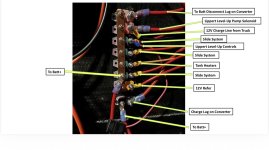
I would send a pic into Alliance that’s what I did and this is the pic they sent back to me on my bus / breaker bar on my 310rl. Just a guess, I would say the different colors are different amp ratings.

IMG_8306.jpeg
 

George

Prominent Member
Cleaning up those busbars and labeling them is my next project. I know two of the circuit breakers on mine so far. The brown wire is my tank heater supply (verify yours) and one of the large red wires can easily be traced back to the hydraulic pump solenoids.
As for un-used breakers — Spares?
You've probably already figured out that the larger busbar is supplied by the battery cutoff and the smaller one is hot all the time. (that's why it's recommended to physically disconnect the battery for long term storage).
 
  • Like
Reactions: UFF
I would send a pic into Alliance that’s what I did and this is the pic they sent back to me on my bus / breaker bar on my 310rl. Just a guess, I would say the different colors are different amp ratings.

View attachment 5225
Good idea so I emailed them.

You've probably already figured out that the larger busbar is supplied by the battery cutoff and the smaller one is hot all the time. (that's why it's recommended to physically disconnect the battery for long term storage).
Actually I had heard of that but had not yet identified why there are two.

Yesterday I tapped threads into the frame crossmember and screwed an old piece of 3/4 plywood to it. I haven't secured the bracket at the bottom yet but I'm not sure it's needed.

There are three factory ground wire connections to the frame and I was pretty unimpressed with two of them. The other one is on the right in this pic and it seems OK, I guess.

To the right of my plywood is my idea of a ground to the frame: another tapped hole with the powder coating removed around it and a 1/0 copper welding cable with a copper end attached with a machine screw. If I had a larger tap I would have used it but it should be a good connection.

32A10InvertBoard.jpg
 
Yesterday I decided that the AC power wires needed to run up through the steel shelf near where they will enter the inverter. There was no appropriate hole in the shelf, so I opened Tom's Metal Shop. This usually ends with me bleeding and frustrated but it went OK yesterday.

Knowing that the wires must be protected from the metal edge, I looked through my inventory of stuff and found compression drain fittings like you have under your sink. I picked a hole saw that was the right size for one of those and passed the wires through it.

I'm not sure why Alliance seems to have an aversion to labeling wires and switches, but the significance of the white tape on one wire is that I tested and learned that's the hot one coming OUT of the panel. If people use the inverter prep, they're going to need to know that answer...

32A10ShelfHole.jpg
 
As I delve into what should be connected to the new distributor, I have more questions about this image:

32A10PosWires.jpg


As George previously noted, the lower bus bar is always hot. The red wire with the green X on it is thus always hot and doesn't have any fuse that I can see. It goes up through the shelf and goes inside a black protector along with the brake control wires and what I'm guessing are turn signal light wires.

The red wire with the blue X on it is hot whenever the main power switch is on and has no visible fuse. It goes inside the black protector with that negative wire with the purple fitting in the foreground. They go up through the shelf and join a large bundle.

What are those?

The yellow one is also puzzling. It has its own inline fuse and is connected with a big blue wire nut to a pretty heavy red wire running back into the camper.

What is that?

I've emailed Alliance about these but have only gotten back the stock "we'll get back to you" reply with a case number so far. It's the weekend and the rally, so they might be a little busy.
 
Things I lay awake thinking about:

We got our first camper a few years ago but I have been around and owned boats all my life. On boats, when you turn off the main battery switch, EVERYTHING is turned off. That seems normal to me.

In campers, there's this "always hot" circuit and the advice to disconnect batteries to fully power down the camper. Umm... that's what switches are for! But I guess that battle has been lost, so we have "always hot" things. OK.

I have been reading and watching videos about inverters and other power system stuff. A useful resource is All About RV's. I swiped this image from them:


AllAboutRVsInverter.jpg


There are lots of similar images. I haven't found one that shows an "always hot" circuit.

They do always seem to show a big fuse or breaker immediately after the fat wire exits the battery.

I'm putting together a similar system but (for reasons I don't really understand) I'm going to need another supply wire from the battery bank running to the "always hot" circuit.

I'm thinking of just re-using the original factory wire but I note that it has no fuse.

I guess this is normal in campers but it seems to me that there should be some kind of circuit protection on the "always hot" supply as well as on whatever that "always hot" red wire that wanders off into the wire bundles is.

Am I just being a weird boater guy, or do others lay awake thinking these things?
 

Jwtsg

Well-known member
No,,,don’t think you are alone on this,,,imho though,,,while not understood W my limited knowledge & understandin, I feel there is a “ known workable solution“ to the always hot issue identified that “ work around” this dilemma. Why Alliance designs don’t seem to recognize & install this in their designs remains a mystery to me however! Happy camping 👍🍀🌞!!
 
  • Like
Reactions: UFF

Oregon_Camper

Forum Admin
Staff member
You don't have emergency brakes in your boat. You need an always hot line to keep brake controller active. Not everyone would remember to turn it on each time. Alliance also made the frig always hot to avoid having food go bad. For less than $10, you can easily put in a battery disconnect at the batter and never have the always hot issue again.
 
You don't have emergency brakes in your boat. You need an always hot line to keep brake controller active. Not everyone would remember to turn it on each time. Alliance also made the frig always hot to avoid having food go bad. For less than $10, you can easily put in a battery disconnect at the batter and never have the always hot issue again.
Actually, my brake controller has a separate power supply, but it's a newly installed disc brake system. So maybe one of those wires was for the factory drum brakes?

In any case, the two red wires with a green and blue X on them in my pic seem to me like things that should have a fuse, but to size a fuse, I would need to know what they are.

Speaking of fuses, all of the wiring diagrams like the one I posted above show a big fuse either directly on the positive battery connection or immediately in the cable leading out.

As it came from the factory, ours had a wire (no fuse) leading to the always hot bus, another wire (no fuse) leading to the master switch, another wire (no fuse) leading back to the switched bus bar, and THEN the self-resetting breakers. Seems like a lot of wiring and connections before you reach the very first circuit protection, but what do I know?

So I'm really wondering about how to size five different fuses:

One on a fat wire leading from batteries to the Lynx distributor, which will carry all loads except whatever is always hot.

One on a smaller wire leading from batteries to the always hot bus.

One in the Lynx for the wire leading back to the switched bus.

One in the red wire with a green X.

One in the red wire with a blue X.
 
I heard from Carter Cantrell at Alliance, who sent me these two images:

Valor-12V-Wiring-Examplepg1.jpg


and

Valor-12V-Wiring-Examplepg2.jpg


Some of this matches my camper, so some mysteries are solved. The yellow fuse and blue wire nut likely leads to my fridge. The connection to the white "always on" breaker with a big red and white wire likely leads to my converter.

Alliance's image shows the power lead from the 7 way connector to the truck being connected to the switched bus but I verified with my meter that the wire with a green X connected to the "always on" bus is that power lead.

I still don't know what the wire with the green X is but I came to a realization about that "always on" bus bar: it is no longer needed. The other realization is that there's no chance we would ever travel with the main battery switch shut off because the rear facing camera is powered through the main 12 volt control board in the kitchen, so that thing must be powered up or we go nowhere.

This means that my Lynx distributor will, in practice, be an "always on" bus bar. Once I turn that switch on at the end of this job, I don't see a reason to turn it back off unless I'm doing some work that requires it.
 

Jwtsg

Well-known member
I heard from Carter Cantrell at Alliance, who sent me these two images:

Valor-12V-Wiring-Examplepg1.jpg


and

Valor-12V-Wiring-Examplepg2.jpg


Some of this matches my camper, so some mysteries are solved. The yellow fuse and blue wire nut likely leads to my fridge. The connection to the white "always on" breaker with a big red and white wire likely leads to my converter.

Alliance's image shows the power lead from the 7 way connector to the truck being connected to the switched bus but I verified with my meter that the wire with a green X connected to the "always on" bus is that power lead.

I still don't know what the wire with the green X is but I came to a realization about that "always on" bus bar: it is no longer needed. The other realization is that there's no chance we would ever travel with the main battery switch shut off because the rear facing camera is powered through the main 12 volt control board in the kitchen, so that thing must be powered up or we go nowhere.

This means that my Lynx distributor will, in practice, be an "always on" bus bar. Once I turn that switch on at the end of this job, I don't see a reason to turn it back off unless I'm doing some work that requires it.
Good info,,,thanks for sharing the info! Hope this helped your discovery and increased your confidence in Alliance support! 👍🍀
 
I haven't heard back from Alliance again yet, but I found another answer. I had the positive wire with the blue X loose along with its negative half and just connected those directly to a battery. The only thing that got power was the leveling system (non-hydraulic on Valorish All Access models). Disconnected and no more power to leveling. So now I know what that one is.
 
Top