• Click here to access some of the presentations made during the 2022 National Rally

Lift Kit Needed?

Meanjean73

Active member
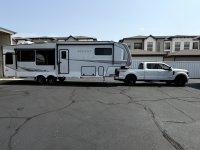
Picked up a new to me Paradigm 310. First 5th wheel but not new to RVs.
The 5th looks nose high and needs to be leveled IMO. I have 6”-7” of bed clearance as it sits now. Adjusting the hitch or the pin box would reduce bed clearance.

So what’s my option? Lift blocks? Anyone have a lift kit they have used? Does it look nose high?
 

Attachments

  • IMG_2091.jpeg
    IMG_2091.jpeg
    440.9 KB · Views: 40

BryanValRox

Elite Member
Picked up a new to me Paradigm 310. First 5th wheel but not new to RVs.
The 5th looks nose high and needs to be leveled IMO. I have 6”-7” of bed clearance as it sits now. Adjusting the hitch or the pin box would reduce bed clearance.

So what’s my option? Lift blocks? Anyone have a lift kit they have used? Does it look nose high?
IMHO, it is hard to tell from the picture. (but the frame line of the trailer looks pretty level, maybe a little higher in the front)
It would be best to take some measurements at the front and the rear to get a true understanding on how you sit. Looks can be deceiving.
You could also place a level inside on the floor to understand how you sit.

Bed rail clearance appears to be more than 6-7 but if you measured it then you know. If confirmed to be on the higher end, this would an option for you to tweak your rig.

I am sure others will chime in.
 

Meanjean73

Active member
I’ll take some better measurements and verify. The B and W is set to the middle height so there’s room to go down 1 “

I take it the ultimate goal is a level rv and min of 6” bed rail clearance?
 
Last edited:

M and E

Prominent Member
Agree with @BryanValRox. Question. Are you running with air bags or adjustable air suspension on the rear? If so, that needs to be dialed in also. Running at higher pressures drives up the rear end to the point where you may not be able to achieve the correct sag on the factory suspension. if you are running with Timbrens specifically manufactured for the F350, most find them to perform better when you delete the additional spacer block (the add on part that sits closest to the frame, it's a disc). I may be stating the obvious, apologies if so, but measure the distance from the ground to the top of the rear wheel well loaded and unloaded. Ideally, one to two inches of sag. More can be okay. You want the front wheel wells to be within about an inch of the unloaded height. Anyhow, I hope this is useful to you and others. You can fiddle with the adjustments at a scale too looking at weights and the distribution to both of the truck's axles which might inform whether you need to adjust the pivot arms on the B&W. Others here know I am a suspension nerd...sorry if this is too much info!

Flipping the pivot arms, more forward, mor rearward, can also adjust ride height because of weight distribution characteristics across the trailer and the truck.

This adjustment process not only improves ride quality, vehicle and trailer control, but also braking effectiveness and load distribution across all axles, tires, etc. Lots of little systems are involved in trailering suspension adjustments...and I obviously find it way too interesting!!!
 
Having 6 to 7 inches from the front of the fifth wheel to the top of the rear truck deck sounds pretty good. Anything less could possibly result in damage to the fifth wheel if you ever hit a dip in the road or cross an uneven road.
 
I don't have data to support this statement, but I think the Curt Helux king pin causes the rig to sit higher in the front than, say, the MorRyde king pin. I plan on lowering my B&W hitch down to help compensate.
 

Meanjean73

Active member
I don't have data to support this statement, but I think the Curt Helux king pin causes the rig to sit higher in the front than, say, the MorRyde king pin. I plan on lowering my B&W hitch down to help compensate.
Not running the Curt, has the roto flex. Side note, I found a guy selling one on marketplace for a good price. He switched to a goose neck something or other. A topic for another post but I’m curious if there are significant benefits to it? Also curious about the added weight on the rear axle if any?
 
Last edited:

Meanjean73

Active member
Agree with @BryanValRox. Question. Are you running with air bags or adjustable air suspension on the rear? If so, that needs to be dialed in also. Running at higher pressures drives up the rear end to the point where you may not be able to achieve the correct sag on the factory suspension. if you are running with Timbrens specifically manufactured for the F350, most find them to perform better when you delete the additional spacer block (the add on part that sits closest to the frame, it's a disc). I may be stating the obvious, apologies if so, but measure the distance from the ground to the top of the rear wheel well loaded and unloaded. Ideally, one to two inches of sag. More can be okay. You want the front wheel wells to be within about an inch of the unloaded height. Anyhow, I hope this is useful to you and others. You can fiddle with the adjustments at a scale too looking at weights and the distribution to both of the truck's axles which might inform whether you need to adjust the pivot arms on the B&W. Others here know I am a suspension nerd...sorry if this is too much info!

Flipping the pivot arms, more forward, mor rearward, can also adjust ride height because of weight distribution characteristics across the trailer and the truck.

This adjustment process not only improves ride quality, vehicle and trailer control, but also braking effectiveness and load distribution across all axles, tires, etc. Lots of little systems are involved in trailering suspension adjustments...and I obviously find it way too interesting!!!

Awesome info and all things I’m trying to learn so thanks for the reply. With all the new info I need to get out there and take some better measurements and see what I can or need to adjust.

My truck is stock but I did add super sway pads to my overload spring perches. They help keep the sag to about 2 inches. I also have a slide in truck camper, that was the initial reason why I installed them.

The BandW is in the middle height position and has the hitch in the 2” forward of the axle.
 

Attachments

  • IMG_2070.jpeg
    IMG_2070.jpeg
    544.2 KB · Views: 9

M and E

Prominent Member
Not running the Curt, has the roto flex. Side note, I found a guy selling one on marketplace for a good price. He switched to a goose neck something or other. A topic for another post but I’m curious if there are significant benefits to it? Also curious about the added weight on the rear axle if any?
I found the helux to be very good. Others don’t like it. I think that’s going to be a very subjective topic, which is fine of course. There are so many variables that make one hitch great on one setup for one owner and the way the use the rig versus another. That said, the Helux sure seems to be well made.
 

Flyer32RLS

Active member
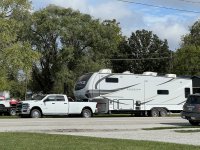
After enlarging your picture, it looks fine to me. Maybe a little noise high but not excessive. I would not worry about it. Money better spent!!
As you can see with ours, it looks about the same.n.
 

Attachments

  • IMG_1271.jpeg
    IMG_1271.jpeg
    383.9 KB · Views: 17

Meanjean73

Active member
After enlarging your picture, it looks fine to me. Maybe a little noise high but not excessive. I would not worry about it. Money better spent!!
As you can see with ours, it looks about the same.n.
Does look about the same. I wasn’t sure how critical it is to have the rv perfectly level? Still learning about 5th wheels.
 

Meanjean73

Active member
After measuring again I had 7.5” bed clearance, lowered the B and W to the lowest setting (17”).
Sitting right at 6.5” of bed clearance. RV sits fairly level now.
 

Attachments

  • IMG_2180.jpeg
    IMG_2180.jpeg
    745.9 KB · Views: 12

Oregon_Camper

Forum Admin
Staff member
After measuring again I had 7.5” bed clearance, lowered the B and W to the lowest setting (17”).
Sitting right at 6.5” of bed clearance. RV sits fairly level now.
Yikes...I think I'd rather be a big nose high than only having 6.5" of clearance. That might be a issue where truck/trailer touch on a steep transistion (say in or out of a parking lot...gas station...etc)
 

Terri&KevinGates

Active member
Yikes...I think I'd rather be a big nose high than only having 6.5" of clearance. That might be a issue where truck/trailer touch on a steep transistion (say in or out of a parking lot...gas station...etc)
IMG_1405.jpeg
I would have to agree. 6.5” is good until it’s not. This was backing into a site at Northshore Landing in Greensboro GA.
 
Last edited by a moderator:

UFF

Well-known member
Well going back to post #9 I would change to 2” behind rear axle. That would move your trailer back 4”. Also would give you more room to drop tail gate really and won’t change much on front axle weight either. Everyone recommends to put hitch forward of rear axle when I think it does not matter much because your b&w hitch is anchored in 4 spots in your bed (less of a change). On my last Ford I had it all the way back and it still added 40lbs to my front end weight (Steer Axle-5,240/5,280). Also remember your fresh water tank is huge and it is located behind your rear axle of your camper. Some run with it full and 800lbs there will also change a lot of things. Well everyone has an opinion and this one is just mine.

With my new truck I have the same issue as you, about an inch high. I am at the lowest point on my hitch so I’m moved my pin box up a set of holes this off season. Will be hitting the scales to finish out the set up.

IMG_7529.jpeg
 

Meanjean73

Active member
Yikes...I think I'd rather be a big nose high than only having 6.5" of clearance. That might be a issue where truck/trailer touch on a steep transistion (say in or out of a parking lot...gas station...etc)
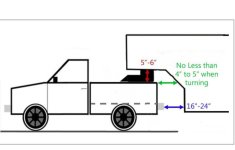
I will move it back up. I found this online so I assumed 6.5" was the goal? Guess that's a bit too close? Guess this answers my question, if I want the RV to be more level and maintain appropriate clearance a lift kit would be needed.

I was hoping that wasn't the case, the front AC unit seems awfully close to my overhead door as it is.
 

Attachments

  • IMG_2069.jpg
    IMG_2069.jpg
    189.5 KB · Views: 8
Last edited:

Meanjean73

Active member
Well going back to post #9 I would change to 2” behind rear axle. That would move your trailer back 4”. Also would give you more room to drop tail gate really and won’t change much on front axle weight either. Everyone recommends to put hitch forward of rear axle when I think it does not matter much because your b&w hitch is anchored in 4 spots in your bed (less of a change). On my last Ford I had it all the way back and it still added 40lbs to my front end weight (Steer Axle-5,240/5,280). Also remember your fresh water tank is huge and it is located behind your rear axle of your camper. Some run with it full and 800lbs there will also change a lot of things. Well everyone has an opinion and this one is just mine.

With my new truck I have the same issue as you, about an inch high. I am at the lowest point on my hitch so I’m moved my pin box up a set of holes this off season. Will be hitting the scales to finish out the set up.

View attachment 4488
My hitch is different from the one in the picture. I don't have as many adjustment locations on the slider. My hitch is directly over the axle when in the foreward position. When maneuvering in tight spaces I slide it back and can still open my tailgate in the rear position.
 
Top