• Click here to access some of the presentations made during the 2022 National Rally

Switch from factory wired circuits to all for inverter

SNadler11

Member
I currently have a 2000 Watt inverter with internal transfer switch (Progressive Dynamice PD1620) wired and working properly feeding the outlets that wer prewired on my 2025 Alliance 29RL. I am considering changing the setup to power the rest of the coach. Mostly the microwave and the remaining outlets. Not really concerned right now with air conditioning as I only have 200 Amp Hours of Lithium batteries although i might just wire for everything in the hope os adding more battery capacity in the future? Does anyone have any practical experience doing this? I would appreciate any advice or tips before i get involved. I dont know what i really need other than a transfer switch or where i have to put the equipment. What happens with the transfer switch in the existing inverter? Or is there an easier way that i am missing?
Thanks!
 

Lantley

Prominent Member
I installed an outlet behind my entertainment center TV area' that is connected to TV outlet. (Inverter circuit)
From there I ran an extension cord through my cabinets to microwave.
I can now power microwave and outlets from OEM inverter circuit. Just some will do
Not exactly what you asked but I see no need to power every outlet
just some will do
 

SNadler11

Member
I installed an outlet behind my entertainment center TV area' that is connected to TV outlet. (Inverter circuit)
From there I ran an extension cord through my cabinets to microwave.
I can now power microwave and outlets from OEM inverter circuit. Just some will do
Not exactly what you asked but I see no need to power every outlet
just some will do
Yes, this does seem like an easy solution. We dont cook meals or anything in it so it is not like we would be running it for more than a minute or two at a time.
 

Lantley

Prominent Member
Yes my goal was to be able to run microwave from inverter. If I'm in a rest area I can have enough electric to heat some thing up in the microwave. It was a rather simple solution. Kind of crude by some standards but it works without too much effort
 

Oregon_Camper

Forum Admin
Staff member
I installed an outlet behind my entertainment center TV area' that is connected to TV outlet. (Inverter circuit)
From there I ran an extension cord through my cabinets to microwave.
I would never run anything on an extension cord, as a permanent solution. Wire it with romex or move the microwave circuit (at the panel) to the inverter "hot" area.

Continuously using an extension cord can lead to overheating, frayed wires, and potential electrical shock due to its flexible design (especailly in an RV traveling down the road) not meant for long-term use.
 

Lantley

Prominent Member
I agree with no extension cord. But I have a microwave outlet already. I don't use the microwave on inverter very often. Actually almost never.
Nevertheless I want the option to run on inverter on those rare circumstances when I need to. I won't do it enough to warrant another dedicated micro outlet or rewiring micro circuit.
My heavy duty extension cord is a easy solution/compromise.
If I were to use micro on inverter regularly I would find a more permanent solution.
 

SNadler11

Member
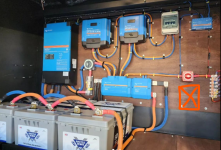
To make this easy....start over. You get a 3000w inverter (Victron) and wire the RV with that. Remove your 2000w inverter that only powers a few outlets.
If i were to start over like this how would i stop the inverted coach from trying to charge the batteries in that loop? Would I cave to turn off the converter all the time or can that be automated some way?
 

Oregon_Camper

Forum Admin
Staff member
If i were to start over like this how would i stop the inverted coach from trying to charge the batteries in that loop? Would I cave to turn off the converter all the time or can that be automated some way?
The Victron MultiPlus will become the "converter" for the RV. You can simply unplug the existing converter or remove it from the RV. I removed mine and donated it to a local RV shop. Here is how my system looks now....except I need a new picture, as I now have a 50 amp DC-to-DC charger installed where the big orange X is shown.

1733443588519.png
 

thearthursx4

New member
Hi All -- new 2025 385FL owner with a similar, but related question, but i've not seen it asked. We have the generator prep and there's a junction box in the front compartment for the generator power. The most recent models come with 12V refrigerator so there's no inverter provided as part of the setup. I believe generator prep included the ATS -- could i add an inverter and wire it to the generator wiring in the front compartment? Obviously it would not run all the circuits the generator could so I would manually turn off the AC breakers, etc.

Thanks, Joe
 

BryanValRox

Elite Member
Hi All -- new 2025 385FL owner with a similar, but related question, but i've not seen it asked. We have the generator prep and there's a junction box in the front compartment for the generator power. The most recent models come with 12V refrigerator so there's no inverter provided as part of the setup. I believe generator prep included the ATS -- could i add an inverter and wire it to the generator wiring in the front compartment? Obviously it would not run all the circuits the generator could so I would manually turn off the AC breakers, etc.

Thanks, Joe
Hi Joe, I am not a professional electrician, so you should reach out to one for advice on this topic. I am sure others on this forum have experience in this area.
The challenge would be your ATS and panel are expecting 50 amp service (L1 and L2 plus neutral and ground). Your inverter will likely only have an L1,N and ground output connections. So the challenge is finding the proper strategy to adapt to feed both legs at the ATS and or panel.
Certainly this equipment (inverters,ATS , etc ) is common in the RV industry. I know many member here have advanced Solar systems and Inverter System, so I am confident it can be done, the question is how is it done safely. I just am unfamiliar with electrical code, so I am not sure if “straps” or splitting a single leg into two or only feeding one leg is safe or permitted.
Just some things to think about, please reach out to a professional to be sure, or pull knowledge from others on this forum with experience in this area.
 

thearthursx4

New member
Hi Joe, I am not a professional electrician, so you should reach out to one for advice on this topic. I am sure others on this forum have experience in this area.
The challenge would be your ATS and panel are expecting 50 amp service (L1 and L2 plus neutral and ground). Your inverter will likely only have an L1,N and ground output connections. So the challenge is finding the proper strategy to adapt to feed both legs at the ATS and or panel.
Certainly this equipment (inverters,ATS , etc ) is common in the RV industry. I know many member here have advanced Solar systems and Inverter System, so I am confident it can be done, the question is how is it done safely. I just am unfamiliar with electrical code, so I am not sure if “straps” or splitting a single leg into two or only feeding one leg is safe or permitted.
Just some things to think about, please reach out to a professional to be sure, or pull knowledge from others on this forum with experience in this area.
Thanks for the quick reply. That makes sense. Really the same as if a 30A generator was connected.
 

JWalker

Well-known member
I agree with no extension cord. But I have a microwave outlet already. I don't use the microwave on inverter very often. Actually almost never.
Nevertheless I want the option to run on inverter on those rare circumstances when I need to. I won't do it enough to warrant another dedicated micro outlet or rewiring micro circuit.
My heavy duty extension cord is a easy solution/compromise.
If I were to use micro on inverter regularly I would find a more permanent solution.
Our rig only came solar prepped. So I am starting from scratch with a small, budget friendly system to use on certain occasions. Clearly not intended full-time and every day use. I'm going to just run two outlets off of our 2000 W inverter. One to the bedroom and one to the TV area in the living room. That should do nicely for the occasions I need to run certain electrical items when I'm not able to hook to shore power.
I would never be able to get my return on investment out of a $20,000 solar system.
 

BryanValRox

Elite Member
Thanks for the quick reply. That makes sense. Really the same as if a 30A generator was connected.
We have the factory installed Onan. it is equipped with L1 and L2 outputs, neutral and ground, so all the connections on our ATS have wires landed on them, so obviously it feeds both legs of the panel.
At the end of the day, I guess all of the “Dog Bone Adapters that we all use from time to time , split or combine legs.
 

Oregon_Camper

Forum Admin
Staff member
Our rig only came solar prepped. So I am starting from scratch with a small, budget friendly system to use on certain occasions. Clearly not intended full-time and every day use. I'm going to just run two outlets off of our 2000 W inverter. One to the bedroom and one to the TV area in the living room. That should do nicely for the occasions I need to run certain electrical items when I'm not able to hook to shore power.
I would never be able to get my return on investment out of a $20,000 solar system.
Based on what you are looking to do with a system (very small) you might be better off with a small / portable "solar genertor" that you can carry to each location you want power. It can be charged while driving. It would also work well in your home too. So for $500, you're ready to go with no wiring done to RV. Now, of course this will not run your AC unit...just simple devices like TV, laptop, etc...
 
Top