• Click here to access some of the presentations made during the 2022 National Rally

Need for DC-DC charger for tow vehicle charging of upgraded LFP battery

Owner of "new" 310RL and getting schooled on the electrical system. Looking at upgrading the existing LA battery to 1 or 2 LFP ones. No inverter. I know to change the solar controller and converter setting. Question is about charging from tow vehicle. Read that TV won't keep LFP charged due to insufficient voltage. Concerned about keeping fridge (12 VDC) cold when travelling. On sunny days, no issue as 320W panel will keep the battery topped off. Question is on rainy/cloudy days. With an LA battery, the TV would keep in topped off but what to do with LFP? Do I need a DC-DC charger in line with the 7-pin 12 VDC wire from the TV to keep the LFP topped off? Am I worried for nothing?
 

2 Allies

Prominent Member
rbflapjack,

We upgraded to one Lithium 300 ah battery, changed settings in the solar controller and the converter and have had no issues. Will add dc to dc if we need to in yhe future. So far so good. We went with an Epoch 300ah Lithium.

Hope this helps,
Bruce
 

BryanValRox

Elite Member
Owner of "new" 310RL and getting schooled on the electrical system. Looking at upgrading the existing LA battery to 1 or 2 LFP ones. No inverter. I know to change the solar controller and converter setting. Question is about charging from tow vehicle. Read that TV won't keep LFP charged due to insufficient voltage. Concerned about keeping fridge (12 VDC) cold when travelling. On sunny days, no issue as 320W panel will keep the battery topped off. Question is on rainy/cloudy days. With an LA battery, the TV would keep in topped off but what to do with LFP? Do I need a DC-DC charger in line with the 7-pin 12 VDC wire from the TV to keep the LFP topped off? Am I worried for nothing?
Well, I would offer that it might not be 100% necessary, but would certainly contribute to “tummy comfort” while traveling.
Remember that the refrigerator, will only experience “Higher Draws” when the compressor kicks in. So, you will have peaks and valley’s in your amp draw on an intermittent basis while you travel. As you already know your converter and solar controller have settings that are used to change the charging profile when hooked to a LFP Battery. So adding a DC/DC would provide the opportunity to optimize your LFP charge rate from the truck on travel days(regardless of weather)
Your solar will contribute some amount of charging even on a cloudy day, so taking that into consideration, coupled with the truck voltage, you could in fact be worried about nothing.
Having said that, we have a DC/DC charger that came installed on our 2024 310 RL from the factory, I have never got confirmation as to why, but my take is it was included in the Bill of Materials as a result of the disk brake option we ordered.
The disc brakes use a 12v hydraulic actuator powered from the coach battery, so we experience more draw on our Flooded Lead Acid battery then the standard offering.
I think this could come down to a personal preference.
Personally, I am glad we have ours as it also acts as a battery isolator, when it isn’t activated by the trigger wire, so there is no risk of depleting the truck battery if the coach remains hooked up for an extended period of time for some reason .
If you choose to go this route, be conscious of your strategy for the trigger wire. Ours was hooked to one of the light circuits, so the lights needed to be on for it to activate. This was not mentioned in the owners manual and really wasn’t an issue for us as we tow with the lights on anyway, but for those that rely on the auto light setting of their vehicle, they could find themselves with a low coach battery.
At the end of the day, I would recommend it.
I would also offer we have towed 11 hours straight twice and have never had any issue with our 12 volt refrigerator or freezer not being able to maintain temperature.( we monitor with a wireless thermometer while traveling)

Decisions, Decisions, Decisions!
 
Well, I would offer that it might not be 100% necessary, but would certainly contribute to “tummy comfort” while traveling.
Remember that the refrigerator, will only experience “Higher Draws” when the compressor kicks in. So, you will have peaks and valley’s in your amp draw on an intermittent basis while you travel. As you already know your converter and solar controller have settings that are used to change the charging profile when hooked to a LFP Battery. So adding a DC/DC would provide the opportunity to optimize your LFP charge rate from the truck on travel days(regardless of weather)
Your solar will contribute some amount of charging even on a cloudy day, so taking that into consideration, coupled with the truck voltage, you could in fact be worried about nothing.
Having said that, we have a DC/DC charger that came installed on our 2024 310 RL from the factory, I have never got confirmation as to why, but my take is it was included in the Bill of Materials as a result of the disk brake option we ordered.
The disc brakes use a 12v hydraulic actuator powered from the coach battery, so we experience more draw on our Flooded Lead Acid battery then the standard offering.
I think this could come down to a personal preference.
Personally, I am glad we have ours as it also acts as a battery isolator, when it isn’t activated by the trigger wire, so there is no risk of depleting the truck battery if the coach remains hooked up for an extended period of time for some reason .
If you choose to go this route, be conscious of your strategy for the trigger wire. Ours was hooked to one of the light circuits, so the lights needed to be on for it to activate. This was not mentioned in the owners manual and really wasn’t an issue for us as we tow with the lights on anyway, but for those that rely on the auto light setting of their vehicle, they could find themselves with a low coach battery.
At the end of the day, I would recommend it.
I would also offer we have towed 11 hours straight twice and have never had any issue with our 12 volt refrigerator or freezer not being able to maintain temperature.( we monitor with a wireless thermometer while traveling)

Decisions, Decisions, Decisions!

I guess one related question is about how the battery is wired up in general (maybe I should put this in a separate post :confused:) The way I understand it, the battery gets its charge voltage from three sources: Solar controller, Converter, and the truck's 12VDC line. Does anyone know how these are actually wired to the battery? Are they and the 12VDC circuits all wired together on one 12VDC bus? If so, it really just comes down to what source is providing the highest voltage I think. In this case, the truck will almost never provide enough voltage to top off the LFP battery. It would be great to see a wiring diagram of the entire 12 VDC system.
 

BryanValRox

Elite Member
I guess one related question is about how the battery is wired up in general (maybe I should put this in a separate post :confused:) The way I understand it, the battery gets its charge voltage from three sources: Solar controller, Converter, and the truck's 12VDC line. Does anyone know how these are actually wired to the battery? Are they and the 12VDC circuits all wired together on one 12VDC bus? If so, it really just comes down to what source is providing the highest voltage I think. In this case, the truck will almost never provide enough voltage to top off the LFP battery. It would be great to see a wiring diagram of the entire 12 VDC system.
As I am sure you know, your converter would not normally factor into the charging while traveling. It could under certain conditions, for example if you were running a genset while traveling.
Can’t get you a diagram, but at the end of the day the connection will either be a direct connection to the battery Or via a buss that is fed from the battery.
Certainly wire ampacity needs respected in any installation.
What is the recommend charging voltage for the batteries your considering? A good DC/DC should have a LFP profile built into it and would boost your trucks charge line input to it by some level.
Most standard automotive charging systems output 13.4 to 13.8 and even slightly higher in some cases.
 

Oregon_Camper

Forum Admin
Staff member
1 - Without DC-to-DC...your truck will supply about 3-5 amps to the RV, this is the same, regardless of battery type.
2 - You will not hurt the truck or the RV by not having DC-to-DC charging.
3 - Your truck will never top off the Lithium batteries without DC-to-DC
4 - I installed the new 50 amp "Orion" DC-to-DC charger and it was a burtal install. Prepare for about 8-10 hrs depending on your skill level. You will need to measure your truck and setup, but it will be a LOT of 4awg wire.
 
Last edited:
Thanks for all the insight. I'm going to leave it as is for now and wait and see if the solar doesn't provide enough to keep the new batteries topped off. If it ain't broke yet don't fix it.
 
1 - Without DC-to-DC...your truck will supply about 3-5 amps to the RV, this is the same, regardless of battery type.
2 - You will not hurt the truck or the RV by not having DC-to-DC charging.
3 - Your truck will never top off the Lithium batteries without DC-to-DC
4 - I installed the new 50 amp "Orion" DC-to-DC charger and it was a burtal install. Prepare for about 8-10 hrs depending on your skill level. You will need to measure your truck and setup, but it will be a LOT of 4awg wire.
Just following up on this. I don't quite understand why installing the DC/DC charger would be a brutal install. Can I not just put it in line with the 12VDC leg coming in from the pinbox 7-pin cable? Not really sure how much amperage that can handle though. Did you run 4awg wire all the way from your TV battery to the DC/DC charger? If so I can see that being a brutal install.
 

Oregon_Camper

Forum Admin
Staff member
Just following up on this. I don't quite understand why installing the DC/DC charger would be a brutal install. Can I not just put it in line with the 12VDC leg coming in from the pinbox 7-pin cable? Not really sure how much amperage that can handle though. Did you run 4awg wire all the way from your TV battery to the DC/DC charger? If so I can see that being a brutal install.
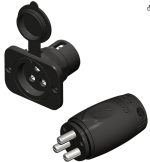
For the 50 amp Victron Orion model I installed, you MUST install 4 AWG (or even 2 AWG if you want to go crazy) from the battery. That is a long run with 2x wires in flexible conduit. This run will terminate around your 7-pin plug inside the truck bed. Then you create another cable run to connect/disconnect there and run that through the hitch to the storage compartment in front, where you have the actual contoller to the battery bank. I went with this marine plug vs Anderson, simply for the ability to keep the plug water proof.

1738020270066.png
 
I have also thought about doing this. The reason a DC to DC convertor is needed is because normal voltage supplied by TV is around 13.4 and a Lithium battery requires 14.4 to get to 100%. So without the step up your battery might only get to about 80% charge. Now the people who have factory DC to DC convertors installed have a 20 amp one due to the disc brake upgrade. I think that is all that is needed as the solar is there to supplement the charge. That would only require 8 gage wire to be run from the TV battery. Yes this requires some work and you have to run the wire back to the camper and use a separate connector as I dont think the standard pins on the 7p can handle the amperage but still checking into that. Any input is appreciated. I dont think the factory installed ones have separate wiring.
 

Oregon_Camper

Forum Admin
Staff member
Ford 7-pin, typical wire gauges are thicker (like 10 or 12 gauge) for high-current lines (Battery/12V, Ground, Electric Brakes), while lower-current signals (Turn Signals, Brake Lights, Running Lights, Reverse) use thinner wires, often 14 or 16 gauge
 
Top