• Click here to access some of the presentations made during the 2022 National Rally

Changing to Lithium on 2026 284RK

carlbergs

Member
Hi Everyone,
This is my first post/question. My wife and I went on our second trip this weekend for 3 days/2 Nights and knew we would be dry camping for the first time but ended up in a spot with tree cover. I won't go into the whole story but watching the battery voltage the final night fall to 11v and below was very stressful. I have ordered a lithium battery and plan to install this weekend.
I know both the Victron solar controller and the converter are Lithium compatible. I believe I have a Wafco converter and know I have the Victron solar controller since I am already connected via blue tooth. My question is will both of these auto recognize the change in batteries? Do I need to change their settings? Is the Wafco converter behind/below the breaker panel under our TV? I hear the fans going but it isn't visible. How would I know they have recognized the battery change?
I appreciate any help in advance.

Thanks,

Shawn
 

Oregon_Camper

Forum Admin
Staff member
Your converter will automatically detect the change from AMG to Lithium...no input needed from you

For your Victron solar controller, you need to use the Victron App to make this change. There is a simple drop down box to pick your battery type.

Once you change to lithium, your 4 LED battery gauge is worthless. Lithium will hold a higher voltage down to about 10% of battery remaining. You will see 4 LED showing 100% charge, until it is waaaay too late. You need to install a battery shunt, which will show you the exact battery level and the amount of amps coming in & out of the battery. The Victron BMV-701 shunt is by far the gold standard. The installation will take about 20 mins.
https://amzn.to/3WbUyfw
 

carlbergs

Member
Jim,
Thanks for the information. The battery I purchased is blue tooth and should tell me the things the shunt would show so I will start with that and if I feel it is lacking I will invest in the Victron shunt.
 

Oregon_Camper

Forum Admin
Staff member
Jim,
Thanks for the information. The battery I purchased is blue tooth and should tell me the things the shunt would show so I will start with that and if I feel it is lacking I will invest in the Victron shunt.
Perfect...if the battery can do that save the $$$ and avoid the shunt for now :)
 

Oregon_Camper

Forum Admin
Staff member
Hi Jim,
Related to all of this, is this the inverter I should be looking at? It seems the highest watts (~1200) for 120v output and 12V input.
I don't know what you're end game is with an inverter.
1 - Power entire RV...including AC units?
2 - Power the "Gen Prep" circuit only?
3 - Just charge phones and laptops...no A/C power needed for RV stuff.

BTW...the inverter you linked, only allows you to plug in a cord to get the A/C output. If you want to use Gen Prep, you need a hardwired inverter to carry the power back via the Gen Prep wiring
 

carlbergs

Member
Jim,
I wanted to go look at the trailer before I replied.
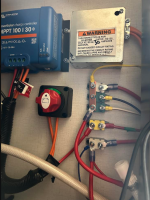
My intent is to use the Inverter loop provided by Alliance and cut the loop romex and insert the inverter. Alliance is very vague in their literature on what is on the loop so that's what I investigated. I just wanted a few simple things - outlet in bathroom, TV and outlet in kitchen - Perhaps a keurig or electric kettle (I just looked and it is 1500W) in the morning, the bathroom just in case (Hair Dryer) and TV for football, golf & relaxing.
So the loop, unfortunately in my opinion, controls every outlet.
So my plan hasn't changed - I would like those 3 things. I noticed in my education it should have a transfer or passthrough mode for when we are plugged into shore power so it stands down.
At the end I think I need a different inverter than I was thinking, perhaps 2000W with the passthrough feature but don't know which one.
I need thick battery cables and I feel that the buses from standard seem like they could be too small to handle 120amps from the battery to the inverter - (1500W/12V=~120A) I think my electrical math, mathes out.
So this isn't something for this weekend but I would like it before spring so ready to educate and take steps in this direction.
Photo I took this evening.
1794365676301.png

Thank you,

Shawn
 

KevinrW26

Member
I have also read that if you convert to Lithium, there will be conflict when connected to the tow vehicle as the tow vehicle battery will be connected to the same DC bus and will have a different voltage. I was understanding that if you want to switch to Lithium that you need to add a DC to DC converter between the tow vehicle accessory line and the trailer DC bus. I want to install Lithium also and when I looked into this, there is an additional issue of limited amperage from my Ram 2500 accessory supply and a decently sized DC to DC converter. Does anyone have any thoughts on this?
 

Oregon_Camper

Forum Admin
Staff member
I have also read that if you convert to Lithium, there will be conflict when connected to the tow vehicle as the tow vehicle battery will be connected to the same DC bus and will have a different voltage. I was understanding that if you want to switch to Lithium that you need to add a DC to DC converter between the tow vehicle accessory line and the trailer DC bus. I want to install Lithium also and when I looked into this, there is an additional issue of limited amperage from my Ram 2500 accessory supply and a decently sized DC to DC converter. Does anyone have any thoughts on this?
Adding Dc-to-Dc is not required when changing to lithium. You truck will be just fine...no damage to anything. The truck only supplies a small amp flow (like 2-3 amps) to the battery bank.

Adding DC-to-DC is nice. I did it a while back and love the extra charging option...when needed. Unless you are boondocking from site to site...running battery bank way down, then it isnt really needed. If you boondock for say 3-5 nights and then go back home or over to a campgroup with power, everthing will be fine.
 
Last edited:

Oregon_Camper

Forum Admin
Staff member
Hey Jim,
Any thoughts on my post two up of the system and the invertor I should buy. We got squirreled with the DC to DC conversation. LOL.
If you're close to Oregon, I have a 2000w WFCO inverter that would work for sale. :) I took it out of our 20' RV, when I moved that RV over to fully supported Victron 3k MultiPlus system

If not, then either a WFCO Wf-5320 or GoPower (linked GoPower one for you)


KevinrW26

Member
Adding Dc-to-Dc is not required when changing to lithium. You truck will be just fine...no damage to anything. The truck only supplies a small amp flow (like 2-3 amps) to the battery bank.

Adding DC-to-DC is nice. I did it a while back and love the extra charging option...when needed. Unless you are boondocking from site to site...running battery bank way down, then it isnt really needed. If you boondock for say 3-5 nights and then go back home or over to a campgroup with power, everthing will be fine.
With the Lithium battery in the trailer at a higher potential than the lead acid in the truck, will it not be trying to overcharge the truck battery?
 

KevinrW26

Member
Jim,
I wanted to go look at the trailer before I replied.
My intent is to use the Inverter loop provided by Alliance and cut the loop romex and insert the inverter. Alliance is very vague in their literature on what is on the loop so that's what I investigated. I just wanted a few simple things - outlet in bathroom, TV and outlet in kitchen - Perhaps a keurig or electric kettle (I just looked and it is 1500W) in the morning, the bathroom just in case (Hair Dryer) and TV for football, golf & relaxing.
So the loop, unfortunately in my opinion, controls every outlet.
So my plan hasn't changed - I would like those 3 things. I noticed in my education it should have a transfer or passthrough mode for when we are plugged into shore power so it stands down.
At the end I think I need a different inverter than I was thinking, perhaps 2000W with the passthrough feature but don't know which one.
I need thick battery cables and I feel that the buses from standard seem like they could be too small to handle 120amps from the battery to the inverter - (1500W/12V=~120A) I think my electrical math, mathes out.
So this isn't something for this weekend but I would like it before spring so ready to educate and take steps in this direction.
Photo I took this evening.
View attachment 5957

Thank you,

Shawn
Hello Shawn,

Can you or someone else identify all the wires going to those 12 volt buss bar and stand alone breakers. My trailer is in storage but wiring looks much the same and I am trying to figure out which wire goes to or comes from converter, my one slide out, the electric jack and the 12 volt fridge none of which are in the 12 volt distribution panel. I am trying to make a circuit diagram for my own troubleshooting knowledge. Let me know and thanks!
 

carlbergs

Member
With the Lithium battery in the trailer at a higher potential than the lead acid in the truck, will it not be trying to overcharge the truck battery?
Kevin,
Everything I have read agrees with your statement about the flow back to the tow vehicle and if you are leaving your truck hooked up while camping unplug the 7 pin. That's my plan. I have had my trailer about 3 weeks and is parked remote but will be heading over this weekend and I'll do my best. I am not an electrician, hence my questions, but I will see if I can figure some or all of them out.
 

Oregon_Camper

Forum Admin
Staff member
With the Lithium battery in the trailer at a higher potential than the lead acid in the truck, will it not be trying to overcharge the truck battery?
Most alternators output over 14 volts. Plenty to power the 2-3 amps going down the small wire.

Todd does a nice job explaining this too
 

KevinrW26

Member
Most alternators output over 14 volts. Plenty to power the 2-3 amps going down the small wire.

Todd does a nice job explaining this too
Thanks Jim! - this is much clearer now! Much appreciated. Would you by chance be able to answer my second question above about which wire is what on the 12 volt dc buss and breakers in the above photograph? I feel that there should be a dedicated wire to the electric jack, the 12 volt distribution and converter, the fridge and the slide-out (I have one). It looks to me like one of the breakers is between the solar 12 volt output and the battery (the middle one). The bottom breaker looks like it has the TPMS repeater prep. and one other large load? The top three breakers I am guessing are fed by battery cut of switch on the left with the jumper bar. I guess the black wire on the right side middle is from the tow vehicle auxiliary. The other two are two more large loads not in the 12 Volt distribution panel. Any light you can shed on these assumptions will be great. Thanks!
 

Oregon_Camper

Forum Admin
Staff member
Thanks Jim! - this is much clearer now! Much appreciated. Would you by chance be able to answer my second question above about which wire is what on the 12 volt dc buss and breakers in the above photograph? I feel that there should be a dedicated wire to the electric jack, the 12 volt distribution and converter, the fridge and the slide-out (I have one). It looks to me like one of the breakers is between the solar 12 volt output and the battery (the middle one). The bottom breaker looks like it has the TPMS repeater prep. and one other large load? The top three breakers I am guessing are fed by battery cut of switch on the left with the jumper bar. I guess the black wire on the right side middle is from the tow vehicle auxiliary. The other two are two more large loads not in the 12 Volt distribution panel. Any light you can shed on these assumptions will be great. Thanks!
Unfortunately, I don't think there's a standard method for how those wires are put together on the busbar. I think you're on track. You just basically need to disconnect each wire and test devices to figure out which is which. This is clearly a 3-4 beer job :)

The larger gauge wires should be going to the slideouts and the landing gear.
 

KevinrW26

Member
Unfortunately, I don't think there's a standard method for how those wires are put together on the busbar. I think you're on track. You just basically need to disconnect each wire and test devices to figure out which is which. This is clearly a 3-4 beer job :)

The larger gauge wires should be going to the slideouts and the landing gear.
LOL - a 4 beer job sounds good!! - will have to wait till spring though as the trailer is in storage. I am trying to plan how I want to prep the trailer for a little boondocking for our big trip to Alaska (from Montreal) next spring. Love this forum and thanks for the help! Too many options and questions running through my head (Inverter, Power Station, Generator (gas or propane) how big, Lithium battery .... lots of fun to study while I am newly retired :)
 
Top